JOHNNY CHAZZ: Sports is a genre within itself when it comes to the movies, and what better time than now to discuss such a genre. With baseball in its peak, football on the horizon and the Olympics just ending in London, the “boys of summer” are alive and well. Let’s use this week on CINEMA: COUNTERPOINT to discuss some of those sports movies that have had the biggest impact on us over the years. Here is Johnny Chazz’s Top Ten:
#10. “61”: What a tremendous story and a film that so few people really ever talk about anymore. Babe Ruth had held the single-season home run record for quite some time until Mickey Mantle and Roger Maris battled it out in 1961. Whether you are a Yankee fan or not, any sports fan will instantly be enthralled with the content and the authenticity of this film. The performances are solid, the casting is specific and on target, and the plot thickens with every scene. The film was directed and produced by Billy Crystal.
#9. “SECRETARIAT”: Being a fan of horse racing, I am compelled to include this 2010 film on my list. With the underrated Diane Lane across John Malkovich, the casting cannot be sold short. Often times this genre can be a bit too “feel good” and “inspiring” for its’ own good, but “Secretariat” does a nice job through and through to tell one of the greatest sports stories of all-time. The final scene at the Belmont Stakes is riveting and the photography along with the musical score is just outstanding when it comes to a racing film. This one can and will bring tears to a racing fan’s eyes.
#8. “BRIAN’S SONG”: James Caan stars along with Billy Dee Williams at the peak of their acting careers in one of the most powerful sports flicks of all-time. Despite racial differences, both men become close friends. The coverage of Gayle Sayers running for the Chicago Bears is one of the top moments in the film. The soundtrack is excellent, the footage is real to life and the story is simply riveting. Consider this one of the top football films of all-time.
The original 1971 trailer for this made for TV film
#7. “MONEYBALL”: This film did indeed receive the credit it deserved, and believe it or not, “Moneyball” actually had an outside shot at the top award with the Academy last year. I recall actually being at OaklandAlameda Stadium the year that the A’s had such a turn-around season in 2002 and I recall a buzz in the crowd that was like no other I had ever experienced at other ballparks. Brad Pitt, Jonan Hill and Phillip Seymour Hoffman put on quite the performance in their roles on screen accompanying one of the best baseball stories of all time. The film was based upon the novel “The Art of Winning an Unfair Game” where manager Billy Beane (still managing today) put a team on the field simply based on statistical methods that were, in every sense – unorthodox. This film comes highly recommended for baseball fans.
#6. “HOOSIERS”: In 1986 this one came as a real surprise to audiences as it had been at least 6 or 7 years since a really solid sports movie had hit the screen. Gene Hackman and Barbara Hershey made a formidable ensemble here as the film takes us through the 1951 Indiana Hoosiers basketball season. Although Jack Nicholson was originally considered for the head-coaching role, Gene Hackman most likely proved to be the right choice. The film focuses on the great athleticism of the team as well as Indiana’s love for the sport. The film is motivating, well-casted, and nostalgic and could easily be considered the best basketball film of all-time. (Note to Jer: You will be pleased to see that my guilty pleasure of 1979’s “The Fish That Saved Pittsburgh” did not make the top-10 list”.)
#5. “MIRACLE”: Here’s a not only a film that has basically been forgotten, but a subject that is not nearly talked about enough. The film was inspired by the United States Hockey Team in the Winter Olympics during 1980. The fact that the “Cold War” was, in a sense being fought on the ice was pure motivation for the American team in this stunning upset as the United States proved victorious in the Gold Medal match over the USSR. Even if you are not a fan of Ice Hockey, it is a virtual guarantee that you will be on the edge of your seat throughout this film. Kurt Russell is outstanding in his role with Patricia Clarkson supporting. The film is a period piece, as well as being one that is quite emotionally impacting especially if you recall the day when the event took place. With the world watching the team rose to the occasion, prompting broadcaster Al Michaels' now famous question “Do you believe in miracles?”
#4. “A LEAGUE OF THEIR OWN”: I am not a Tom Hanks fan to say the least, but here is a film that must make my top-ten list. Released in 1992, audiences everywhere seemed to take to this film and Director Penny Marshall did not disappoint. During World War II, it was the “women” who created a league of their own to entertain baseball fans on the home front. The performances by all are actually quite convincing and the score for the film is appropriate for the time period. Geena Davis, Madonna and Rosie O’Donnell are well casted here and offer just enough “attitude” to actually make them seem as though they are real ball-players. It was the love of the game that brought all of the players together, and each characters is developed well-enough to tie the film together at the end. Tom Hanks as the team manager is humorous and offers a performance that is timely and charismatic. I recommend this one anyone who has yet to see it as it does stand the test of time.
#3. “EIGHT MEN OUT”: The makes my top three without any hesitation. The very fact that professional sports remains “under the microscope” even today is a testament to the message delivered in this film. The film centers around the true story of the 1919 Chicago White Sox (often referred to as the “Black Sox”) who were accused of throwing the world series in order to make money for themselves from underworld crime bosses and bookmakers. The ‘Sox were a virtually guarantee to win the series over the Reds, but since the odds were so high on the other side, the ‘Sox took a fall for the short money. Some people do not consider this film to be one of their favorite sports movies since it casts a poor light on how we actually “romanticize” baseball in the early years. Yet, we realize the impact of the statement by the young fan who states “Say it ain’t so Joe…..” (referring to “Shoeless” Joe Jackson). Based on the performances (John Cusack, D.B. Sweeney, Christopher Lloyd and Charlie Sheen), the musical score and the attention to detail, this must be considered one of my favorite baseball and sports films of all-time.
The original 1988 trailer for EIGHT MEN OUT
#2. “RAGING BULL”: This was perhaps one of Robert DeNiro’s best films and certainly ranks among his best “sports” roles considering there were only a couple. As a matter of fact, it probably ranks among one of Scorsese’s best with the same token. Still, this film must be in my top three considering the tremendous direction, score, plot and amazing performances throughout. Cathy Moriarty plays Jake a Motta's (DeNiro) wife and Joe Pesci is in the role of his brother Joey. The fight scenes are classic, the sound in the interiors is impeccable, the editing is bold and the scenes inside the ring are perhaps the best of any boxing movie ever. This is an absolute must-see for any sports fan.
#1. “THE HUSTLER”: There was never a doubt that this film would fall into my top slot. Paul Newman and Jackie Gleason star in this 1961 play-like film that is not only one of the top sports films of all-time, but easily ranks in my top-50 of all-time American films. The interior sets are genius as well as the script which was so, so smartly written. George C. Scott also puts on such an amazing and intense performance that he almost overshadows our main characters. Directed by Robert Rossen, the film has Oscar written all over it in so many different categories. The interior sets are classic and refined as well as the billiard action and the angles used by Rossen to create tension within a small space. Pool professional Willie Mosconi trained Paul Newman to shoot such a smart game for the role as the film moves towards the final match between Eddie (Paul Newman) and the “classy” and “refined” Minnesota Fats (Jackie Gleason).
The original 1961 trailer to THE HUSTLER!
So, this is Johnny Chazz’s take on the top-10 sports films of all-time. I realize that some of you may question why I left out films such as "Rollerball", "The Pride of the Yankees" and "The Natural" - and believe it or not, I almost included "The Fan" as I really loved the modern-day message it sent. Still, I had to narrow it down to ten, and that is easier said than done. Now, hit this one Jer as I toss the ball into your court.
JER: The ball is caught and served… great topic as we wheel away from the summer months and we work around the plates before sliding into home! I have always been a little more selective about my sports films and I realize that I am not as diverse in that world as you are, JC. Nonetheless, a great film is a great film- regardless of the genre or theme. With that said, I attempt to create my own Top Ten List of Sports Films:
#10. MAJOR LEAGUE: It’s comedy, it’s baseball and it had Charlie Sheen before he was a total ASS! (I mean that from my own personal experiences with Mr. Sheen!) Following the road of the disastrous Cleveland Indians through their epic fails, the team begins a new year under new management who will actually benefit from their losses. The team gets wind of this and turns their game around to bat- out a great season. The 1989 cast includes Tom Berenger (PLATOON), Rene Russo (LETHAL WEAPON 4) and Wesley Snipes (BLADE). Play Ball!!!
#9. BEND IT LIKE BECKHAM: 2002’s sleeper hit about an 18 year old Punjabi daughter (Parminder Nagra from Television’s E.R.) growing up under a strict Orthodox family, must hide her passion to play football (or American soccer) and befriends another 18 year old (Keira Knightly from THE PIRATES OF THE CARIBBEAN) who plays for the same league under their male coach (Jonathan Rhys Meyers from Television’s THE TUDORS). The film captures the life and times of West London from both a typical English family’s point of view as well as the traditional aspects of life for a London- raised Punjabi family while grasping onto their culture and traditions. The film is both funny and touching with real heart captured by its director/ writer Gurinder Chadha.
The entertaining trailer to BEND IT LIKE BECKHAM
#8. THE LAST BOY SCOUT: A bit far off the field, but an action- packed football film taking place in the heart of Los Angeles. Directed by the recently deceased Tony Scott (TOP GUN, UNSTOPPABLE) the film follows a washed- up detective (Bruce Willis) as he takes on the assignment of assisting an ex- quarterback (Damon Wayans) in cracking a murder case involving a pro football team and a politician. The 1991 film carries all the explosive elements needed for a great action film for its day: written by Shane Black (LETHAL WEAPON) and produced by the legendary Joel Silver (THE MATRIX, DIE HARD) collaborate to create a wallop of an adventurous flick! Did I mention that football was the premise of the story?
#7. CADDYSHACK: How could this classic 1980 comedy not be on anyone’s list? With an unforgettable cast of characters including Chevy Chase (VACATION), Rodney Dangerfield (BACK TO SCHOOL), Bill Murray (GHOSTBUSTERS) and Ted Knight (Television’s MARY TYLER MOORE SHOW and TOO CLOSE FOR COMFORT) on top of being directed by triple- threat writer/ director/ actor Harold Ramis (GHOSTBUSTERS, VACATION), CADDYSHACK introduced an entire generation to golf with screwball wit! Things aren’t as posh as they would seem within the greens of the exclusive Bushwood Country Club as golf caddies compete for the annual college scholarship amidst an unstoppable gopher who threatens to tear up the entire course while illegal gambling, drug use and insanity take over the course and destroy the prestige name of the Club along the way!
#6. FIELD OF DREAMS: 1989’s fantasy- baseball drama had only one message to deliver:” If you build it, they will come” and so the film discovers many different layers as what the meaning of that phrase takes on for many different characters and the subplots that the film covers. Kevin Costner (THE UNTOUCHABLES) leads the cast as an Iowa corn farmer who hears a haunting voice whisper the memorable phrase as a request to build a baseball diamond in his field to have the 1919 Chicago Black Sox players return for a game. The film focuses on the discovery (and rediscovery) of family, values and the love for America’s game. The fabulous cast also includes James Earl Jones (COMING TO AMERICA) and Ray Liotta (GOODFELLAS).
#5. ROCKY: The 1976 drama introduced America to its next great hero: Rocky Balboa, who was brought to life by its writer and creator- Sylvester Stallone. ROCKY symbolizes the American Dream to become somebody and to prove that anything is possible as long as the spirit to go the distance lives in the soul of the pursuer. Directed with a flare of realistic drama, John G. Avildsen (1984’s KARATE KID) helms the story of a small time boxer from Philadelphia who gets a once in a lifetime shot at fighting the heavyweight champion. Balboa trains for the match of his life for honor and self- respect. With memorable performances by Talia Shire (THE GODFATHER), Burgess Meredith (Television’s BATMAN) and Carl Weathers (PREDATOR), ROCKY has found its place with its fans as a film with heart and guts.
#4. THE NATURAL: Although missing from JC’s list of favorites, it is one that happily finds a home on mine. Robert Redford plays a middle- aged batter who comes out of nowhere with his self- made bat taken from a tree that had been struck by lightning to help a 1930s losing baseball team to the top of the majors in this fantasy drama. Beautifully directed by Barry Levison (RAINMAN) THE NATURAL contains some breathtaking cinematography and inspiring music from composer Randy Newman (TOY STORY, RAGTIME).
The exhilerating trailer for 1984's THE NATURAL
#3. YOUNGBLOOD: This may not ring on the top of JC’s Top 1000 list, but it sure has a place on mine. 1986’s YOUNGBLOOD might have been a starring vehicle for its main star, Rob Lowe (ST. ELMO’S FIRE) but the film proved to be more than that. With Patrick Swayze as a mentor, Lowe plays a farm boy who wants to play real hockey, so he hops over the Canadian border to play. He has to; however, show that he can move about the ice and being able to hit the puck is just the start. The film features some great hockey sequences as well as a great 80s soundtrack to boot to make this film a fun little treasure for anyone who enjoys the game or the era.
#2. THE BAD NEWS BEARS: I am not talking about that piece of crap wannabe remake with Billy Bob Thorton, but thee original Bad News Bears of 1976! Walter Matthau turns in a memorable performance as the sloppy but loveable Coach Buttermaker who happens to be a down- on- his- luck ex minor leaguer who takes on a league of juvenile little- leaguers as they compete for the California league. With a fantastic cast of pint- sized unknowners, Tatum O’Neil (PAPER MOON) is the jewel on this scuffed tiara as the team’s secret weapon pitcher.
The original 1976 trailer for THE BAD NEWS BEARS!
#1. RAGING BULL: What more can be said of director Martin Scorsese’s true- story telling of the rough and rugged life of prize fighter Jake “The Raging Bull” LaMotta. Robert DeNiro’s portrayal of LaMotta earned him a much deserved Academy Award for Best Actor. The unique style of electing to shoot the film in black and white created an element different from any other film during its release year of 1980. Scorsese has a flair of selecting the right actors to interact with each other that continually add to the drama or tension of the story being told. Joe Pesci (GOODFELLAS) is a break- out star as Jake’s brother, Joey. Another interesting fact that Scorsese built into the production of the film: the fight sequences are recorded in full stereo so that you may hear every hit and jab thrown while the actual dialog or drama of the film is recorded in mono!
The classic opening sequence to RAGING BULL
Great films that deserve a moment of reflection and their enique way of capturing the spirit of the sport they represent... however, it is also understood that many films were overlooked. What do you feel were films that deserve to be recognized?
We always look forward to your comments and please check back as we always reply back to all!
PLEASE join us on Wednesday September 12th as CINEMA: COUNTERPOINT pays tribute to the loss of one of Hollywood's most recognizable and talented Directors: MR. TONY SCOTT (1944- 2012)
Have you visited the official CINEMA: COUNTERPOINT page on YOUTUBE? Check out classic and contemporary trailers, scenes and other great trips down memory lane! Just click the link and check out the "Favorites" on our site! Enjoy!
JER: The summer of 1975… the thought brings me back to when I was a mere seven year old boy falling deeply in love with the movies and who viewed the world through innocent and naive eyes. Amongst the many that were released that summer, the more memorable were titles like ROLLERBALL starring James Caan, Barbra Streisand’s FUNNY LADY, MONTY PYTHON AND THE HOLY GRAIL, Walt Disney’s THE APPLE DUMPLING GANG with Bill Bixby, Don Knotts and Tim Conway, NASHVILLE (a JOHNNY CHAZZ favorite) and the long awaited FRENCH CONNECTION II with Gene Hackman. In the mix of the famous and not- so- famous of the films being released and anticipating release, one film did ‘emerge’ from the depths of a young director’s vision that would change film- watching and film- making all together. The date was June 20th, 1975 and the phrase ‘blockbuster’ was coined from the display of box office dollars generated from a single film that had not been seen previously: It began with Steven Spielberg’s JAWS.
Fast- forward to the summer of 2012, or 37 years later, with yet another wave of excitement that is making its way back into the hearts (and fears) of film fans alike as JAWS is preparing to be released on blu- ray for the first time ever! Serious collectors and first-timers are bogging the internet with talks and conversations of high anticipation as the date draws nearer.
It is no secret that many have heard of the various plights JAWS was cursed with… some would even go as far as to down-play the film as ‘corny’ or ‘boring’ by today’s standards. Who could be afraid of a rubber shark in a world of computer- animation and high- tech graphics or be submitted to suspend reality for the briefest of moments to believe such nonsense? At the same token, how can one argue with the fact that JAWS has remained on the top of many prestigious film lists as ‘best’ in its categories and the respect it has garnered from fellow filmmakers alike?
The blu- ray trailer for JAWS (in HD)
In this posting, CINEMA: COUTNERPOINT would like to recall one of the greatest summer films of all time as well as the one film that may have created the phrase "blockbuster" and the many layers of enjoyment it has provided. So, grab your tanning oil and your beach blankets and let’s dive right into the world of JAWS.
ORGINS:
Benchley makes an appearance as a Reporter in JAWS
JAWS began in the imaginative mind of author Peter Benchley when his novel was published in 1973. Benchley was inspired by a number of true- life shark incidents including a string of attacks that occurred in New Jersey back in 1916. The results led to four deaths and occurred over a period of twelve days. After writing his book, film producers Richard D Zanuck and David Brown (DRIVING MISS DAISY, THE SOUND OF MUSIC) were able to obtain an unpublished copy for their reading. An offer was made by the duo for the film rights and Universal Studios was signed on to release the film. As the film grew closer to a production point, Benchley was asked to co- write the screenplay... he even makes an appearance in the film as a news reporter during the 4th of July festivities. The question now needing to be answered was who would direct the project? Many names were immediately brought forth, but the team of Zanuck & Brown was looking for someone who could visually tell the story and capture the spirit of the novel and what Benchley was trying to convey in character and events. Yes, who indeed…
28 year old director Steven Spielberg
A very young 28 year old Steven Spielberg was already a contracted director for Universal who was quickly creating a name and reputation for himself. Aside from being one of the youngest on the lot, he had already had the honor of directing various top- A actors on television shows that included the likes of Joan Crawford (NIGHT GALLERY) and Peter Falk (COLUMBO). A made- for television film starring Dennis Weaver called DUEL was released in 1971 on NBC and received rave reviews and ratings. His feature length film was made with 3 million dollars and starred a very dramatic Goldie Hawn in THE SUGARLAND EXPRESS (1974) which also received great critique and grossed over 12 million dollars worldwide. The film was produced by the team of Zanuck & Brown.
Having had a wonderful experience working with the new kid on the lot and proving himself ready to go to the next level, Zanuck & Brown decided to give Spielberg the project to direct. Everyone, including, Spielberg, knew the risks involved from the anticipation levels expected by the fans of the novel, since it remained the number one best seller for 44 weeks!
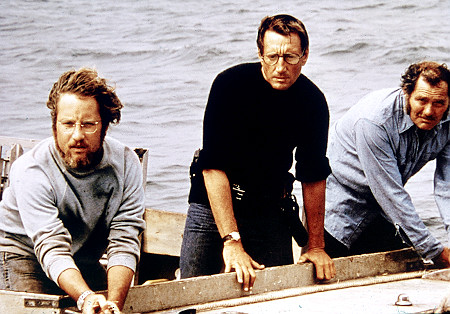
After selecting the quiet seaport town of Martha’s Vineyard as the perfect location for the fictitious town of Amity Island, Spielberg could now focus his attentions on selecting the three main actors to flesh- out the leads of the story. The perfect combination of Roy Scheider as Chief Martin Brody, Richard Dreyfuss as Matt Hooper and the ‘seadog’ portrayal of Quint by veteran actor Robert Shaw was finally drawn out from many other considerations which included Charlton Heston (Brody), Lee Marvin (Quint), Robert Duvall (Brody), Jeff Bridges (Hooper) and Jon Voight (Hooper). Peter Benchley’s dream cast: Paul Newman, Robert Redford and Steve McQueen!
Composer John Williams: circa 1975
JOHN WILLIAMS- JAWS’ HEARTBEAT:
Undoubtedly, the soundtrack to JAWS is synonymous to the film and is easily one of the most recognizable pieces of contemporary classic music over the years. Composer John Williams had already begun what would be his longtime musical relationship with Spielberg by scoring THE SUGARLAND EXPRESS and JAWS would now mark their second collaboration. Williams was proving himself to be a successful and respected composer with scores like FIDDLER ON THE ROOF (1971), THE POSEIDEN ADVENTURE (1972), THE TOWERING INFERNO (1974) and EARTHQUAKE (1974) already adding to his credits. The most distinguished of the JAWS score is its theme. Probably one of the most satirized pieces as well; the theme consists of the memorable low notes provided by tubas and strings. Many wonderful themes are sprinkled throughout JAWS in various points of the film: some are to highlight the anticipation of suspense and others play with Amity’s beachfront scenery as the backdrop.
The theme from JAWS video with stills from the film
Cinematographer Bill Butler on the set of JAWS
A REVIEW- THE FILM:
This is a film that made an impressionable impact on a seven year old who wanted to go to the movies to see a film about a shark…and that was exactly what I got! Even at my age, the distinct sounds of Williams’ soundtrack making an appearance before we get the first shot of the ocean’s floor caused an entire theater to react with excitement. Director of Photography Bill Butler ingeniously used the camera as the shark’s point of view. Rumor has it that Spielberg was so frustrated with the huge percentage of the mechanical shark’s breakdowns, that he was succumbed to use the camera as the shark since the other one is inoperable! Nonetheless, the technique proved to be unique and effective as we were taken on a ride to see what its next victim would be.
Shaw, Scheider and Dreyfuss from JAWS
The arguable question has always been a counterpoint of theme to what JAWS is defined as: is it a horror film or not? An “eating machine” works as the protagonist of the film with one job to perform…eat human flesh. The other side of the spectrum resorts in its rating of PG with a clause appearing on its theatrical posters stating “may be too intense for small children.” The carnage in question is inserted at various moments throughout the film as dramatic moments are given equal time to help developing the personalities of the town’s inhabitants and the main characters. This is another point that makes this film stand out and carry a stamp of its generation. Time is actually spent developing characters and storylines instead of focusing on a total body count with an unlimited array of victims available for feeding and bloodletting. Would one automatically assume because of tension, blood and a shark thrown into a story or film that it could default to it being defined as ‘horror?’ I wouldn’t. Maybe at seven years old, the only vivid memories would be of the shark attacks and it would have definitely been defined as a horror film, but I see it very differently today.
JAWS, in this critic’s opinion, has always been a story of men and struggle…a claiming of grounds. Man versus beast, if you would, over territory. The territory, in the film, is Amity and its waters. A peaceful town that is brought up early on in the film when Brody makes it into the office that fateful morning in which his duties as a lawman is to deal with kids karate- chopping neighbor’s picket fences! How does a quiet little town deal with a bully or a menace? The shark is also a threat to the community… not only because of the fatal effects one would suffer if swimming near it, but also the economic expectancy of summer (more specifically, 4th of July) dollars that the town needs to keep afloat. The town has to get together to try to resolve the problem (claiming their ground) and the solution arises in…the form of one man, Quint. Such similar stories have been told many times before but with different scenarios. The struggle of man and his surroundings is a tale as old as time and makes it more relatable because of our own personal experiences.
"Bruce" the shark and Steven Spielberg
Sadly, there are now at least two generations that never have or never will have experienced JAWS in an actual theater. In 1975’s presentation at my local movie house, the lights dimmed and the film immediately began! No trailers, no commercials, no cartoons, and no concession announcements…just straight to what you paid your price of admission for! There was a quiet hush that went over the entire auditorium yet there was a wave of whispered enthusiasm that made people strap in for the ride they paid to see.
In conclusion, JAWS still remains a very powerful and impactful film for me 37 years later. It works on so many levels: terror, biting humor, action, drama, suspense and tension. If one can look past the “rubber shark” theory, you find a fantastic and ageless storyline that speaks to each of us based on our own personal attitudes or emotional histories. I, for one, find myself waiting in high expectation for the August 14th release date for the blu- ray having once owned the VHS tape and the DVD. If you have not experienced blu- ray and are either curious or intrigued by the comparisons, I was able to provide an example for your viewing pleasure.
JOHNNY CHAZZ: Right off, we must realize that the text (the novel) provides us with a storyline and characters that are much deeper than the film can offer. Still, doing justice to the film, novels are a longer "read" than films are as a "watch". Nonetheless, a sacrifice is almost always made when you take a novel and put it on screen - and so much of the creativity, characterization and imagination is lost ("The Da Vinci Code" would serve as a prime example).
The film won three (3) Ocscars and was probably deserving of that. Still, this was a year that provided us with the likes of "Dog Day Afternoon", "Barry Lyndon", "Nashville", "One Flew Over The Cuckoo's Nest", and Michelangelo Antonioni's "The Passenger" which was arguably the best film of that year.
Spielberg's work here almost reminds us of a "Hitchcock-like" film in the way it is filmed and shot. A quiet town is used and the characters are slightly flawed which adds to the hostility and rage. The characters are limited with plenty of extras in the background.The suspense is real - but timed beautifully and is never overwhelming. Even the play of tension between the three main characters in the film create a mood in a limited space which is drama to a "T". Robert Shaw undoubtably offers the most riveting and convincing performance in the movie.
Jer asked our readers if this was a "horror" film - and that can be debated. The truth is, Jaws appears to fall into the "Monster-Suspense" genre that we often see with "B" movies - and, not to diminish the film - in so many ways "Jaws" does remind us of what "B" movies were all about.
The original trailer for the 1975 release of JAWS
What is so powerful about "Jaws" is that it continues to stand the test of time. The story remains relevant today and upon re-visiting the film, your fear of going in the water re-surfaces all over again. It simply terrorized movie audiences 37 years ago, and continues to do so today.
"Jaws" is hardly a complex film, but the best moments of the film (to me) are when the shark is not present. The moments of floating endlessly and hopefully on the 'Orca' (the boat's name) with the John William's score and the sounds of the ocean water crashing against the boat create a real creepshow feeling. Referring to Jer's comment: It may well qualify as "the most recognizable pieces of contemporary classic music over the years". To add, the underwater cinematography is quite terrific and offers audiences the shark POV that tacks on to the terror. "Jaws" is in no way one of Spielberg's best films as we must look at 3 or 4 others ("Schindler’s List" - 1993 & "Close Encounters Of The Third Kind", as well as "E.T.: The Extra- Terrestrial" and "Saving Private Ryan") before moving down the list to this cult-classic.Still, something special was certainly created here since focus on character was still a piece of the film that made it work. What we can say, and beyond a shadow of a doubt is that "Jaws" was the film that set the stage for Steven Spielberg, placing him on the map for years to come and re-defined the horror-suspense-monster genre for years to come in the world of cinema.
Robert Shaw (Quint) delivers the "Indianapolis"speech
JER: April 6th, 2011 was a date in which CINEMA: COUNTERPOINT posted a blog topic entitled: "THE TOP 25 SCREENPLAYS IN THE LAST 50 YEARS!" to which I listed JAWS as my number 10. To borrow a quote from that posting, here is what I wrote then about JAWS as a screenplay:
10. JAWS (1975) Like THE EXORCIST, what is mainly lacking in the capturing of an audience’s interest in any modern horror/ thriller is the lack of character and dialog. Peter Benchley’s best selling novel is reshaped into a building of characters on both a human and caring manner and how the lives of some change when confronted with an uncontrollable being. A highly recognized moment is placed on Robert Shaw’s “Indianapolis” speech delivered on the ‘Orca” to Richard Dreyfuss and Roy Scheider. Plus, who can forget the immortalized “You’re gonna need a bigger boat” line?
In summary, I go back to what JOHNNY CHAZZ said in regards to: "Jaws" is hardly a complex film, but the best moments of the film (to me) are when the shark is not present. I believe that moments like Quint's delivery of the incident on- board the 'Indianapolis' is one of the greatest moments of dialog assembled and captured on film. There are plenty of great sequences to confirm JC's quote as well. Moments within the Brody household, The various fisherman arguing before casting off the docks to try to win the reward money and the two fishermen who uses the wife's holiday roast as bait that fateful dusk eve. This and many other elements help with the actual telling of a story and not just focus on the carnage of a potential R- rated film.
Shaw, Sheider, Spielberg and Dreyfuss on the set of JAWS
It may be high time for a revisit or maybe the opportune moment to see it for the first time, in any repsects, JAWS is definitely a film to sink your teeth into!
As always, we look forward to your comments on the subject... what has been your JAWS experience? Were you able to see it in theaters or have you only seen it on a home- format?
Mark your calendars as JOHNNY CHAZZ will look into his crystal ball for the inspiration to kick- off his latest blog topic on WEDNESDAY AUGUST 22nd, 2012! Thanks again for visiting us!!!
Have you visited the official CINEMA: COUNTERPOINT page on YOUTUBE? Check out classic and contemporary trailers, scenes and other great trips down memory lane! Just click the link and check out the "Favorites" on our site! Enjoy!
JER: The feeling of déjà- vu hovers over my laptop…haven’t we been here before? The subject of writer/ director David Lynch has been an on- going topic between JOHNNY CHAZZ and me since we first met and began talking about the directors we enjoyed the bodies of work from the most. So, I guess it is slightly embarrassing to admit that Mr. Lynch never came up as a subject to discuss here on CINEMA: COUNTERPOINT before. Let me clear that up just a bit more…his films and his life has been discussed to a certain degree in previous postings but a full blog page topic line has never been dedicated to him solely. I will give that credit to Reader Janelle for bringing up her ‘obsessed’ following with several of his films and the need to read and discuss more of his film history and a slight visit into his biography as well.
If you are an avid fan or a first timer into the realm of David Lynch it comes with a warning: once you have journeyed into his cinematic “rabbit hole”… you will never be the same. Lynch’s unique and controversial methods have been the topic of numerous discussions since he made his feature- length debut with the cult classic ERASERHEAD back in 1977. Some would go as far as to call him a genius… others would just call him insane. Jurors, I leave it to your interpretation, after all, that is what Lynch has always asked of his audiences in the first place.
NOTE: (Please visit our previous posting dated 2/13/2012 entitled “A HYPNOTICSTATE OF BEING”, which further discusses techniques that offer a ‘dream- like’ ambience to its storytelling).
BIO: David Keith Lynch was born in Missoula, Montana in 1946, a town very similar to the little ‘heartland” locations that many of his films take place in. He expressed a love for art at a very early age and signed up for many classes before enrolling into Boston’s School of the Museum of Art just after high school. In the art of expressing himself through his works, he quickly picked up the media of film.
After ‘experimenting’ with a few shorts, Lynch’s first full- length film took almost five years to finish and was finally completed and released in 1977 as ERASERHEAD. Right from the very beginning, many studio executives didn’t know how to receive or market this very strange film until a distributor by the name of Ben Barenholtz took a chance and helped launch the film to its current cult status.
It wouldn’t be too much longer before Lynch entered into mainstream filmmaking when he released 1980’s THE ELEPHANT MAN. David Lynch received two Academy Award nominations: Best Director and Best Screenplay. The film was a success on both a critical and commercial aspect and this secured a position to continue directing and writing a number of films. He found a way to work on both mainstream films as well as independent projects with the same flare and artistic curiosity that has kept audiences guessing to this very date.
This only marked the tip of the iceberg for what Lynch had in mind. After the commercial and critical success of THE ELEPHANT MAN, famed producer Dino De Laurentiis (BARBARELLA, RED DRAGON) sought Lynch out to direct his most ambitious project to date: filming Frank Herbert’s classic sci-fi novel, DUNE. Plagued with too many studio decisions and on- set egos, Lynch was very dissatisfied with the experience of the 1984 film that subsequently bombed in the box office. An extended ‘special edition’ was released on both television and DVD, to which Lynch requested his name be taken off the director’s credit. The name of “Alan Smitee” appears in its place, the name commonly used as a “John Doe” amongst directors who have no claim on their films. It was back to the drawing board for his next project.
A Tribute to David Lynch's 1984 release DUNE
Redemption came in the form of 1986’s BLUE VELVET. Middle America’s suburban town is literally ‘turned on its ear’ when an underlying of darkness and depravity takes over. Things are not as they would seem under the microscope. The film would receive only one Academy Award nomination: Best Director- David Lynch. The film also marked the first collaboration with Music Composer Angelo Badalamenti who composed the eerie and haunting themes throughout the film. Lynch would develop a wonderful relationship with the composer throughout the years including a wonderful and intriguing music video piece featuring some original compositions by Badalamenti and featuring vocalist Juliee Cruise on 1990’s INDUSTRIAL SYMPHONY #1: THE DREAM OF THE BROKENHEARTED.
1990 was a banner year for Lynch has his media outreach made its way to both cinema and television. WILD AT HEART would reunite Lynch with his BLUE VELVET actress Laura Dern and match her with the equally unique acting of Nicolas Cage. Cage went through an odd Elvis phase in his life and brought that into a number of his films including HONEYMOON IN VEGAS and SNAKE EYES. Lynch gave him his iconic snake- skinned jacket and allowed him to snarl on the screen with much enthusiasm. The same year also launched the highly anticipated television series TWINPEAKS which was produced by Lynch. A variety of other credits were held during production including director and writer of a few episodes and he even made an appearance as an actor in the reoccurring role of FBI Regional Bureau Chief Gordon Cole. Lynch centered a teenage girl’s murder on a sleepy logging town tucked away amidst a scenic backdrop of trees and mountains. The series only lasted two seasons ending in 1991.
Lynch would keep himself busy for the next eight years with various projects including his continued work for television and even directing and writing a feature length film released in 1992 entitled TWIN PEAKS: FIRE WALK WITH ME, considered to be the prequel to the events that led to the death of its main character, Laura Palmer. Many of the short- lived television series returned in their original roles for the film. Music was provided by Angelo Badalamenti (who also wrote the series’ music) as well as an appearance by Juliee Cruise as the Roadhouse singer… both of whom were mentioned in Lynch’s INDUSTRIAL SYMPHONY #1 feature- length video.
Captivating video of Juliee Cruise's theme from TWIN PEAKS
THE STRAIGHT STORY could be taken in a literal sense when it was released in 1999. Richard Farnsworth walked away with the only Academy Award nomination for the film as its lead character, Alvin. Based on a true story, the film focuses on how a 73 year old man from Laurens, Iowa rode on his lawn mower to Mt. Zion, Wis. in 1993 to mend his relationship with his ill 75 year old brother, Lyle. The film offered a rare glimpse at how Lynch was able to ‘slow down’ the process of telling a story without the use of overblown budgets or heavy special effects. Some would even dare interpret this film to be Lynch’s most ‘normal’ entry to date.
2001’s MULHOLLAND DRIVE would remain true to the unique and bizarre views of Lynch… Hollywood- style. A freak auto accident on the twisting roads of Mulholland Drive would leave a woman (Laura Harring) amnesic. Her destined run- in with an actress hopeful (Naomi Watts) would team together to piece the clues as to the woman’s identity. The original storyline and premise was derived from a television film Lynch directed and wrote back in 1999 of the same name.
Again, Lynch would take some time from feature films to work on television segments and video documentaries between 2001 and 2006 to finally release the last of his feature films to date: INLAND EMPIRE starring re- occurring actress Laura Dern. Lynch would, again, center this story around Hollywood and the film industry as Dern’s character is an actress preparing for the biggest role to date. As she begins to develop feelings for her co- star, she finds her real life mimicking that of the fictional life of the film she is making. It is only then that the film takes a turn for the surreal and the lines are blurred from that moment on. The third half of the film was shot on the opposing side of Hollywood Blvd. better known as the poorer side. Having walked down those very same streets personally, I can tell you that a certain residue permeates of urine and filth. It is far from the tourist attractions of the Walk of Fame, the Chinese Theater and the Pantages… yet; close enough to be a stone’s throw away.
Not more can be mentioned of the latest works by Lynch. After 2006 on through to the present 2012 would have Lynch occupied with a number of videos and shorts. 2011 had Lynch work on a video documentary with legendary 80’s pop band Duran Duran entitled- DURAN DURAN UNSTAGED. Think of it as a concert film on hallucinogens. Leave it to Lynch to film the concert in a standard black and white and super- impose images over the images of Duran Duran’s lead singer Simon LeBon, keyboardist Nick Rhodes, drummer Roger Taylor and bassist John Taylor. Everything from smoke, flames, sunbursts and even bizarre shrunken heads make their way onto the screen to obstruct the performance itself.
Duran Duran's "Careless Memories" from Lynch's UNSTAGED
LYNCH: THE DIRECTOR’S EYE: In this critic’s opinion, I believe that David Lynch is the modern day side- show barker. He entices and attracts a curious audience to his world of oddities…and we cannot help but look without tearing our vision away from it, much like driving slowly past an automobile accident. We are left to revel in bewilderment, possibly disgust but always with a sense of wonder. His films leave us guessing and maybe even left to our own devices… much like a believer is left pondering the meaning of life. Is it too cerebral for an average audience? Is the idea of “getting” his films mean “not getting it”? If so, then what is the point then?
The same can be said of an artist, though. The work of an Expressionist is to let the viewer derive their interpretation or perception of what they see. Much so are the films of Lynch as well… he offers no explanation in interviews nor does he leave a director’s audio commentary track on any of his films’ releases on DVD or Blu- Ray. After all, weren’t the origins of film created as yet another canvas for artists looking to go beyond paints and brushes? Lynch is, without argument, an artist who has decided to essentially use the camera as his molding clay or paintbrush or charcoals and allow the raw film to be displayed on its canvas: that being the screen. Like an exhibit, we pay to see the works of the artist by purchasing a ticket at the box office or renting or buying his films. We are poised and (somewhat) ready to be taken on the journey of the creator. Some are left satisfied and conversations arise… others look upon with discuss, confusion and questions.
Maybe we, the audience, had it wrong all this time. What if film was just meant to be another art form and we didn’t need the clarity of story and scripting? What if film didn’t have dialog? Could the artist still express what needed to be said in the same format as art without words? Did ‘experimental’ film makers like Andy Warhol, the latter films of Stanley Kubrick or German and French Expressionists know what the concept was really meant to be used as? There is a lot to be asked with a lot to be answered…
JER’S TOP 3 LYNCH FILMS:
For the record, let me say how much I have and always will respect the works of David Lynch. He is bold and does not compromise his work for the general public. It was very difficult to center my attentions on only three, but I also wanted to keep the forum very open to my eagerly- awaiting “counterpoint” partner, JOHNNY CHAZZ. So, without further ado, here are my personal selections.
#3. THE ELEPHANT MAN: Mainstream, yes. Artistic, absolutely. The true story of the tragic and inspiring life of John Merrick couldn’t have been captured any better by any other director in 1980. Taking a bold step and presenting a mainstream film (released by Paramount Pictures) in black and white was a risk that paid off in its essence of presenting the grotesque disfigurations of Merrick as well as the interpretation of the seedy streets of the lower dredges of England.
The moving trailer for 1980's THE ELEPHANT MAN
Anthony Hopkins is highly underrated as Frederick Treves, the Victorian surgeon who rescues the young John Merrick (John Hurt) from the physical beatings and mistreatments as a side- show freak who suffers from a rare disfiguring congenital disease. The film represents the 19th century with excellent set design and cinematography. The film was bestowed 8 Academy Award nominations including the previous Best Picture and 2 nominations for Best Screenplay and Director for Lynch as well as one for John Hurt for Best Actor. Nominated for Best Original
Score, John Morris adds the final somber touch with saddening themes for Merrick and the menacing moments of Merrick’s inhabitance of the side- show.
***Here is where it gets to be a little unsure. The safe “go- to” title should be BLUE VELVET… and why not? Widely considered to be the most popular film directed by David Lynch, it was also the most successful in all markets. However, it isn’t about making a ‘safe’ decision within my “top 3 films” … it is more about the overall presentation and how I felt about it long after seeing it. Thus, BLUE VELVET is an excellent film and deserves all of the accolades it continues to receive…but, let’s just say that other films deserve equal time in the spotlight and I want to shine it upon them.
#2. DUNE: I know that many people were extremely harsh and turned off by this film…not only because of the hard- to- follow style that Lynch presented the film in, but the story and characters didn’t work for a general audience back in 1984. DUNE is heavy science- fiction with multiple storylines and various characters belonging to various families to keep track of. I must admit that I am a big fan of and the owner of the special extended edition (Alan Smitee) and not the original ‘David Lynch’- direction version. I feel that the stories and events are fleshed out better because the additional material lends in the development. Lynch’s version was probably the victim of executives’ cutting away the general works and pared it down to a senseless telling.
#1. MULHOLLAND DRIVE: Admittedly, my main attraction to this film has always been because of the fact that it takes place in and around Hollywood, CA. Obviously, there is way more going on in this film than its location to grab my attention. The two different story lines occurring here dabble in the innocence and the corrupted. Life seems to play a difference between both sides and the film gives us that devil/ angel opposition. Hollywood rests in Los Angeles or “City of Angels”, yet, it is also recognized as a city of corruption, crime and violence. Both sides arise in the course of the film with do- gooders and haters doing their best (or worst).
JOHNNY CHAZZ: I must admit that Lynch has been one of my favorite and most relished film directors over the past 20 + years since my initial viewing of a private screening of "Blue Velvet" on the USC campus in 1988. Thus, it is so inspiring and motivating that we have the opportunity to discuss Lynch and his films this week.
One common theme that we see in Lynch films is that of the "dream-state" surrounded by abstract art, if you will. So many people walk around life in the "conscious" realm whereas Lynch comments on how the subconscious and the conscious state... affect one another on a cyclical basis. One look at Lynch's "Lost Highway" or even "Mulholland Drive" would affirm that point.
What is KEY this week on our blog is to remember that when we discuss an artist and a director such as Lynch, we must keep in mind that everyone is seeing a "different" image and storyline on the screen - similar to taking a group of people to the museum of modern art. Everything on the screen is an expression of the mind and an abstract piece of film that is thrown at audiences in fragments (a theme to be discussed later).
Dreams and life are synonymous in the world of Lynch in the sense that they can go from a thing of beauty to terror in a moment's time. "Eraserhead" might be one example, but "Lost Highway" and "Mulholland Drive" probably offer primer examples of that phenomenon.
As for plot - that is basically irrelevant in the world of Lynch - heck, look at the recent film "Inland Empire" by Lynch - tremendous to watch, but the plot is a violently weaved and disturbing conundrum. It is the "experience" itself that matters and the mood (lighting, color, and sound) that surrounds it which makes Lynch's films so original, and often disturbing with the same token. I often wondered if the "Lady in the Radiator" (Eraserhead) was an homage to the films of Hiroshi Teshigahara in the 1960's - specifically "Woman in the Dunes". His films are also quite intriguing including "Face of Another" (1966) and "Pitfall" (1962).
Jer listed "The Elephant Man" and "Dune" in his Top 3 this week - so I will go ahead and comment on those films as well as list my Top 5 and eventually my Top 3 as it gets narrowed down.
"The Elephant Man" as Jer mentioned certainly was quite impacting for the time period and Jer makes a strong selection - at least in terms of the caliber of film we are dealing with here. Still, is it one of Lynch's Top 3? Hard to say - and art remains subjective does it not? Still, the film was a stray from Lynch's typical dream-state motif and was so much more dramatic in terms of plot and straight narrative ("The Straight Story" falls in that realm as well). I cannot list "The Elephant Man" in my Top 3 however as it is not a film that really defines Lynch as a director, nor does it reflect who he is and the true message he is sending to audiences. Nonetheless, "The Elephant Man" was outstanding in itself and must be remembered on that level.
"Dune" is perhaps the least entertaining film in Lynch's repertoire. I choose not to spend much time discussing what I feel was, without a doubt his most dull and meaningless film he ever directed. Not only do I not place it on the bottom of Lynch's entire film-work, but I am not sure it could even be classified as a rating level 5 in respect to most films out there. We might recall that Roger Ebert declared it to be the "Worst movie of the year!" So, just when you think Lynch is flawless, take a look at "Dune" - just miserable. Moving along…
Here are Johnny Chazz's Top 5 Lynch Films from #5 to #1:
#5. "WILD AT HEART": This is simply a stunning piece of work with cinematography and set design that was second to none. The flamboyance of the film weaved in with the colors and the eroticism made for a perfect scenario to play off of. Laura Dern and Nicolas Cage were extremely well cast here and Diane Ladd is utterly convincing. The film still has that "dream-like" and nightmarish quality while still maintaining a focus on plot and narrative. The writing and sound are strong fixtures in the film and it should be remembered as one of Lynch's most unique films re-defining his image in Hollywood in 1990.
#4. "ERASERHEAD": Lynch's debut feature film is a fantastic piece of criticism, surrealism as well as insightful and astute. Henry is the main character whose life has been turned upside down and "The Lady in the Radiator" who is a source of solace for Henry (an angelic character who also has nightmarish qualities - but also exists as an inner conscience to Henry and the decisions he has made as to the child's welfare) and the "Man from the Planet Beyond" are staple characters in defining Henry's existence.
"The Lady in the Radiator" from ERASERHEAD
The death of the baby scene may very well be seen as a commentary on the cruelty and gruesome idea of abortion - maintaining a dreamlike and hallucinatory quality. From the opening shot, the terror of the film is real - and audiences are in for a frightening and disturbing ride. How could the film not be made in black and white? What a touch and another quality of Lynch's early masterpiece adding to the horror and alienating facet of the film. Henry's psyche and the desolate sets / scenery are also areas where the "black and white" motif fit just right. The film is extremely complex and was filmed primarily at night on an extremely low budget.
Lynch has quoted that "No one has come close to interpreting the meaning of "Eraserhead". Still, the film will continue to be studied and broken down by critics and film students alike for years to come.
#3. "BLUE VELVET": We see in "Blue Velvet" the idea of the "underlying" of what appears to be a perfect town - a nightmarish theme that would also show itself in "Twin Peaks" (as mentioned by Jer) and later in "Mulholland Drive". This was a brilliant comeback film for Lynch after the "Dune" disaster. Sex and violence along with corruption and murder appear once again - but this time in a type of parody within the apparent "perfect town”.
The haunting trailer for BLUE VELVET
The scenes become tenser as main character Jeffrey (Kyle MacLachlan) becomes submerged in the world of Dorothy (Isabella Rossellini) as he forms a romantic and almost disturbing sexual relationship. However, on the flip side, his relationship with Sandy (Laura Dern) is sex-less and lacks any real passion which is almost a turn of the screw (no pun intended). Frank Booth's character is magnificently played by Dennis Hopper and only adds to the tension and bizarre mystery of the film which is really about the altered reality (just look at the duality of the opening scene of the film) and the surrealism that lies beneath the surface. Jeffrey is living in a world that collides with another - and the film as well as Jeffrey switches styles from a 50's superficial melodrama to a "voyeuristic" and disturbing piece of work.
The film is certainly a test of audience endurance with a style that is not plot driven - but rather an emotional roller coaster ride with plenty of eye-candy.
#2. "INLAND EMPIRE": Lynch's most recent work was absolutely phenomenal once again as 2007’s "Inland Empire" brings back Laura Dern as the main character with Jeremy Irons and Justin Theroux. The plot is similar to "Mulholland Drive" because it is about a woman, an actress yet again - in deep trouble. Dern (Karolina Gruszka) is terrific and was actually deserving of possibly a Best Actress nod for her performance in the film - especially the final act.
The original trailer for Lynch's INLAND EMPIRE
As Lynch mentioned, the script for the film is a composite of ideas that is then broken into fragments. Lynch simply came up with these fragments of ideas and then shot the scenes accordingly until the film began to unfold and mesh into a work of art. Lynch's love for the country of Poland also surfaces, adding the dimensionality of the film and curving the narrative of the film. “Inland Empire” is presented into three parts and also play as "Acts" - with Act 1 being a dream-like state (similar to what we see for the majority of "Mulholland Drive"; Act 2 is a nightmare in a sense and Act 3 is focused on performance and script that is second to none.
One might say that some and perhaps all of the characters in the film never really existed and only live in Laura Dern's "mind". There are countless scenes where Dern is walking through dark hallways and corridors only to encounter another aspect of the dream-state and altered reality (the "rabbits" scene is a prime example).
All I can say is to watch the film, let it soak - absorb everything you can and then take a break....then, re-visit it about three (3) times until the picture is clearer. Oh, and it may not be - but you will be better off- no doubt. It is a fine film with a performance given by Dern that is simply off the charts.
#1. "MULHOLLAND DRIVE": This film, along with "Inland Empire", are certainly deserving of top honors and are the epitome of what defines Lynch and how good he really is and can be. The film is a mystery with a deep dark secret hidden inside a box opened by a blue key. The scenes inside of "Winky's" are nightmarish in quality - yet maintain the dream-like state with the hazy and bright lighting coming in through from the windows. The scene at "Club Silencio" is magnificent in every way with a performance cover tune of Roy Orbison's "Crying" that is utterly convincing even though we are brainwashed that everything is an illusion.
Naomi Watts (specifically the audition scene), Laura Harring and Justin Theoroux offer outstanding performances throughout the film and the appearance of Ann Miller and Robert Forster are wonderful treats for the audience. The film is really about the making of a film - thus, we, as an audience, are also diving into the blue box and we too hold the key. Some critics might claim that “Mulholland Drive” is difficult to watch since the emotions expend the story or narrative - yet that is precisely the point and the idea conveyed by Lynch through the canvas of film.
Drive down MULHOLLAND DRIVE...if you dare!
Jer discusses the idea of "Hollywood" being highlighted and promoted in this film - and that is just another character that defines the theme of the film allowing the audience to experience the way Lynch views the movie industry and the surroundings.
The film "Mulholland Drive" is an abstraction - there is really no easy understanding as Lynch only wants to focus on "the experience" where audiences are being asked to use their intuition to gain a greater understanding. In a sense, describing and analyzing a Lynch film is similar to telling someone about a dream you had last night. The receiver does not understand the real impact and meaning of the dream, but YOU did - and you will never forget the strongest of dreams for as long as you live. That is what makes Lynch and his films so, so effective in the world of art and cinema.
JER: Points taken and greatly received. As much as I admire the works and I “get” the angle that Lynch comes from, I have always felt like I ride shotgun to JOHNNYCHAZZ’ take and understanding of what Lynch’s concept has always been about. This is why we have gotten along all of these years. I feel we both continually educate each other with our individual concepts and perceptions and we either communicate or beat each other over the heads with the view points we want the other to understand!
Well, being that JC got two more films on his “top” list than I did- I can only mention that both BLUE VELVET and WILD AT HEART would have rounded off my total five. There isn’t more I can add that JC didn’t cover other than this was a well- versed topic that needed to be discussed in detail.
We sincerely hope you enjoyed this week’s topic as we turn the keyboard over to you. What are your thoughts on the works of David Lynch: genius or just a lucky loony? What are your favorite Lynch films and why? Why not? The conversation goes beyond the page and we await your comments and all will be replied on.
Please check back with us on Wednesday August 8th, 2012 as we reveal a new topic by JOHNNY CHAZZ. Until then, thanks for always stopping by and for your continued support!
Have you visited the official CINEMA: COUNTERPOINT page on YOUTUBE? Check out classic and contemporary trailers, scenes and other great trips down memory lane! Just click the link and check out the "Favorites" on our site! Enjoy!


 #6. “HOOSIERS”: In 1986 this one came as a real surprise to audiences as it had been at least 6 or 7 years since a really solid sports movie had hit the screen. Gene Hackman and Barbara Hershey made a formidable ensemble here as the film takes us through the 1951