Wednesday, August 27, 2014

FILM RECOMMENDATION ON THE MONTH: AMADEUS TURNS 30


Wolfgang Amadeus Mozart. The name is iconic and recognized both domestically and internationally throughout the centuries. Composer, show man, prodigy… drunk, womanizer, crass. Any and all words can be and have been used to describe one of the greatest classic composers the world has ever known. All words are also suited in describing the mad genius whose musical compositions came so effortlessly, as if taking dictation in class from his instructor. The untold story of Mozart was the subject of a major motion picture that garnered recognition from critics and audiences alike as well as winning eight Academy Awards including Best Picture in 1985. This little introduction leads me to my current topic: MY FILM RECOMMENDATION OF THE MONTH: AMADEUS.
FLASHBACK: THE EARLY 1980s
It is vastly inconceivable to remotely comprehend the notion that this motion picture is celebrating its 30th anniversary from its original release on September 23, 1984! Ah, yes… good ol’ 1984. The once futuristic title of George Orwell’s novel was now a very realistic year bountiful with entertainment on the silver screen. The year 1984 gave us such memorable films like: GREMLINS, GHOSTBUSTERS, PURPLE RAIN, BEVERLY HILLS COP, A NIGHTMARE ON ELM STREET, THE KARATE KID, THE TERMINATOR, FOOTLOOSE, THE NEVERENDING STORY, ROMANCING THE STONE, INDIANA JONES AND THE TEMPLE OF DOOM, SIXTEEN CANDLES, REVENGE OF THE NERDS, RED DAWN and THIS IS SPINAL TAP… this was only the tip of the iceberg in title recognition and they all came out within one single year and all celebrating their respectable 30th as well.

The real Mozart
Getting back to my subject, I had just turned a young and precocious 16 years old that summer and enjoying the fruits of the cinematic labor. My mother, being of the classic musical background, constantly played the compositions of the likes of Beethoven, Bach… and Mozart, my personal favorite, around the house. The music was familiar to me and was threading into the fabric of my life at a very early age. In my early high school years, it had come to my attention through a school- related publication, that a Broadway play of Mozart’s life had been adapted and was starring none- other than Mark ‘Luke Skywalker’ Hamill in the lead production simply entitled AMADEUS.
Mark Hamill as Mozart

I still remember the black and white photo that showed Hamill dressed in his best mid- 18th century wardrobe sitting next to the harpsichord looking young and enthused. I immediately devoured the article about the play and came to find out that it was the telling of Mozart’s life through music and dramatic interpretation. Information was scarce back in the 80s with no internet to gather additional articles. I would have to wait and see if this production might come to my nearby Los Angeles' stages; again, using limited resources for updates. The show slipped through my fingers.
The light had not dimmed just yet, for here I was, as an anxious 16 year old gobbling up ghosts and gremlins that Summer, to surprisingly be treated to the early Fall’s submission of award- worthy quality films… the film adaption of the play I had read about just a few years ago: AMADEUS was now a major motion picture event!
STORY SYNOPSIS
The tale of Wolfgang Amadeus Mozart (Tom Hulce) is told through the confessional narration of Italian- born composer, Antonio Salieri (F. Murray Abraham) who weaves his tale to a visiting priest (Herman Meckler) while being confined within an institute after a failed suicide attempt. The subject of the talk was that Salieri pled forgiveness for killing Mozart.
F. Murray Abraham as older Salieri
Now an old man, Salieri began his story when Mozart was a child prodigy. Having been personally tutored and trained to read and play several classical musical instruments by his father, Leopold Mozart (Roy Dotrice), Wolfgang began writing music at the age of 6 and was composing symphonies and operas at the age of 12. Salieri, in the meantime, was just a few years older than Mozart and was still playing with his fellow street companions, regretted his father’s unsupportive attitude in Salieri’s musical interest. He emulated the idea that Mozart had become famous at such an early age and received mentorship by his father, touring throughout the country and having the honor of  performing for royalty. After the death of Salieri’s father, he quickly moved to Vienna and began his musical education. Becoming a young adult, he constantly prayed to God to bless him with talent in His honor and requested success in the compositions he would write. Mozart, in the meantime, had already grown into his own popularity and conducted numerous public and requested performances that showcased his music.
Salieri meets...
Salieri was overjoyed to hear that Mozart was coming to Vienna, having been invited to perform at an exclusive event hosted by the Archbishop himself. At last, the eagerly awaited moment in which he might finally meet his composing inspiration, Wolfgang Amadeus Mozart, in person. Having never seen his image before, Salieri took it upon himself to look at the faces of the young men in attendance to see if he could pick out what Mozart might appear like. He would have to present himself with an ere of intelligence and brilliance… maturity and talent would essentially be etched in his features and mannerism. Having found himself in the private dining room, now filled with only the finest in the culinary selections, he heard a squeamish young woman’s shrills as she was chased by a young man in the most immature manner. Obviously two young fools who were playing a childish version of hide and seek, Salieri hid under one of the tables, only to witness the vulgar behaviors of this upstart of a boy as he teased and manhandled the young woman. Then, music began… it was a new composition of Mozart playing in the main hall.
... Mozart (Tom Hulce) for the first time
At that moment, the boorish young man rocked Salieri’s senses as he stated that HIS music had begun without his presence! THIS was Mozart! Salieri couldn’t believe his eyes as his perception of the talented composer was shattered by the reality of the imbecile before him.

It was shortly after this encounter that Salieri elected to renounce his belief in God. How could He waste such precious gifts on someone who didn’t deserve or appreciate them? It was at that moment that Salieri waged a bitter war against both God and Mozart… neither deserved the attention or respect from him. He would do everything within his power to befriend and ruin Mozart personally.
Emperor (Jeffery Jones)
Fate brought the two musicians together at last. By this time, Salieri was now the private tutor and court composer to Emperor Joseph II (Jeffery Jones), who had a love for classical compositions. Mozart was invited by the Emperor himself to not only visit him, but enlisted the talents of Mozart and requisitioned him to write an opera for the National Theatre. After the acceptance of such a prestigious request, Mozart elected to stay in the city of musical composers and accepted Salieri’s friendship in return.

A young Salieri (Abraham)
Salieri: a tormented soul, indeed. Never once had he allowed himself to relish in his own success as he spent time plotting on sabotaging Mozart’s music, ideas for operas and even his personal life. Every plot within his conspiracy was aimed to fuel the personal vendetta towards his own God, making it his mission to destroy His musical angel. His soul grew darker and bitter, yet, there was still the inner fixation and passion towards Mozart’s music that was undeniable. He could hate the man but not his compositions.
Constanze Mozart (Elizabeth Berridge)
Having ignored his father’s request to return back to his native Salzburg, Mozart stayed in Vienna and defiantly took on a wife, Constanze (Elizabeth Berridge), on August 4, 1782. He rode on the cusp of success and was looked upon as the toast of the town. He had nothing but a deep admiration for his father, although portrayed in a strict but cautiously caring manner, one could almost analyze that Mozart sought Leopold’s approval on the successes of his musical abilities. It could easily be thought through that he recognized the hard hours of mentoring could now be paid- off by his fame. Money was coming in and Mozart spent exasperating hours, even sleepless days and nights, dictating music that flowed in his head like a running brook onto paper. The music couldn’t be shut off; it drowned his senses as if listening to the music on full volume in an isolated chamber. Then, the drinking, the endless parties and the countless women and visitations to brothels soon followed. Constanze could only silently witness the downward spiral into his personal abyss as she turned a blind eye to the reckless behavior her husband portrayed. 
Leopold (Roy Doltrice)

Mozart had taken on more musical commissions than he could handle, money was becoming scarce due to his frivolous spending and lack of proper financial savings. The drinking was constant and the late nights out were now a routine procedure as he would sneak out once all were asleep. The balancing act of his actions would finally crash upon the notification that his father, Leopold, had suddenly passed away! This was an extremely devastating blow to Mozart, having abruptly realized his childish behaviors and the obvious ignoring of returning back home.
The tormented spirit DON GIOVANNI
The year was now 1787… a very odd and almost too coincidental occurrence was revealed in Mozart’s timeline, as he would debut his darkest opera yet: “Don Giovanni.” The story surrounds a mixture of dramatic overtones mixed in with supernatural elements. A tormented soul within the opera was, by Salieri’s account, believed to be that of Leopold himself, returning from the grave to continue consuming Mozart’s soul with guilt.
The mysterious messenger
Almost immediately following the tragedy, Mozart received a very mysterious request to compose a requiem in honor of a dead man. The name was not revealed nor was the messenger who remained in a black cloak with an emotionless black facial mask. He was, within the same time, composing a light farce of a musical intended for the common people of Vienna… the compositions would become “The Magic Flute.” The complete contrast, mentally, to be able to write both a saddened and dark requiem and then to off- set the balance out by flipping mental channels on composing a whimsical and frilly humorous opera. How does one even begin to emotionally prepare for such polar opposites?
The Enchanted Queen from THE MAGIC FLUTE
“The Magic Flute”, now completed, premiered in 1791 to a roaring and well- entertained audience, feeling emotionally and physically ill, Mozart was in attendance. His demeanor was pasty; the pallet was pale and slightly yellowish. Also in attendance, sitting high in a balcony, Salieri watched both the composer and the composition. During his confessional talk with the priest in the institute, the elder Salieri admittedly revealed that it was he who had dressed as the dark- cloaked messenger and tormented Mozart like the spirit in “Don Giovanni”, almost copying the costume worn on stage. The requiem in question would serve a darker purpose with a plot not yet mentioned.
Having finished “The Magic Flute”, Mozart tried to concentrate on the requiem. The anonymous messenger had consistently added pressures to have the work completed, but he was too ill to continue on it alone. His conditions worsened as Mozart collapsed during a performance of “The Magic Flute”, to which he conducted and accompanied with instrument. Salieri, ever present and attended as many performances as possible, witnessed the incident and arranged and rode on transportation to return Mozart home. He made sure that he was placed on his bed and noticed that Constanze was not present. It came to pass that she had enough of Mozart’s ill- advised behaviors and retreated to a nearby resort for rest. This was the entrance Salieri needed to Mozart.
Salieri assists Mozart with the Requiem
Barely having the strength to continue penning his requiem composition, looked to Salieri for assistance. Here was the man who had made the request himself of Mozart and was now asked to help. The underlining intention was even worse than expected… a sly smirk curled over the lips of the elder Salieri as he continued his soul- baring confession to the priest. The internal plot would finally inform that the requiem was intended for Mozart’s very own death and that Salieri would take full credit for the composition as a homage to his dear and fellow musician! The plan was coming to a close.
The music comes faster than it can be written
The notes, movements and instruments spewed from Mozart’s breath as if he delivered a memorized monolog. Salieri barely kept up while he tried desperately to comprehend the ideas being shared. A large portion had finally been dictated when Mozart requested a brief rest to try to regain strength. Salieri greedily overlooked the musical sheets when he was suddenly interrupted by the unannounced arrival of Constanze. Inquiring why he was in their home, Salieri informed her of Mozart’s illness and how he had been assisting him with the compositions. She pulled the sheets out of his hands and forbid Mozart to write anymore, locking the composition in a glass case… blaming his fatigue on the harsh and constant work strain he had been under. The sheets were now away from the hands of the composer and the conspirator.
Mozart meets his fate
Constanze approached their bed in which Mozart laid quietly. She whispered his name as to not startle him from his sleep… but he was not asleep. His eyes, staring emotionlessly towards the ceiling, were glazed and without reaction. On December 5, 1791, Wolfgang Amadeus Mozart was dead at the age of 35. Two days later, Mozart was laid to rest in a common, unmarked grave, as was the typical customs of Vienna for the time. A very small collection of close family and friends were present. Salieri was present as well.

Salieri's last words to the priest
The sun rays had beamed through the barred window in Salieri’s small room, the elder composer sat with a satisfied look on his face as he gazed upon the reaction of his confessor. The priest, in tears, oversees Salieri… the thoughts of a monster and tormentor must have passed through his silent lips. A male nurse walked in on the two men and collected Salieri, as it was time for his bath and breakfast. Rolled out of his room in a wheelchair, Salieri delivered his final words to the priest… a tortured soul meant to suffer 32 years later after Mozart’s death. Where was God’s justice? Taking his angel and allowing his music to live forever and burden Salieri to live on with the guilt and suffering of becoming old and to personally witness the slow distinction of his own music. He considered himself the voice for all mediocrities in the world. He was their patriot saint… the slow downward decline of sanity could barely hold on as he was whisked away with his tortured soul fully intact. The never- ending music of Mozart still played within his mind, never to let the conspirator rest for his wrong doings until his own death would, maybe, set him free at last.
PRODUCTION ORGINS
Shortly after the preview of Peter Shaffer’s new play, AMADEUS, premiered at the National Theater in London on November 2, 1979, an audience member made a declaration about the work. That person was none other than Academy Award- winning director Milos Foreman (ONE FLEW OVER THE CUCKOO’S NEST) stating that he had the subject for his next motion picture and would dedicate the time necessary to properly present the story in its most classical and authentic interpretation possible.  
It would take nearly two years later to have Shaffer finally agree upon the collaboration for the screenplay in 1982. The project became an obsession, as the two men locked themselves away from the public in a Connecticut farmhouse for 4 months, hatching out the plot, story and dialog. After the screenplay had been completed, Foreman contacted producer Saul Zaentz, who shared in the Academy Award victory for ONE FLEW OVER THE CUCKOO’S NEST. Zaentz was on board with the project and suggested that they enlist box office stars for the roles. Foreman was against it, envisioning how unacceptable it would be to have Mozart played by a recognizable face.
Almost a year later, after auditions from both Tim Curry and Mark Hamill as Mozart were held since they played Amadeus on stage in various productions, had the cast finally been rounded off and the production could begin filming in Prague, Czechoslovakia, the best location offering a re-created setting of 18th- century Vienna.
Special Effects artist Dick Smith works on Salieri's make-up
Keeping production moving along was an arduous task for both Foreman and Zaentz. Tom Hulce perfected his keyboarding skills and practiced 4 hours a day and actually played every note himself as Mozart. F. Murray Abraham had to learn how to read and conduct music for his role as Salieri. Abraham had to endure an estimated 4 ½ hours of make- up by Special Effects master Dick Smith (THE EXORCIST) to create the elder Salieri. Smith would later win the Academy Award for Best Make- Up Effects for his work on AMADEUS.
Peter Schaffer
Play and screenwriter Peter Schaffer actually broke down and cried when he visited the Theatre of the Estates in Prague, knowing that Mozart had actually premiered “Don Giovanni” there almost two centuries ago. Aside from a few sections within the opera house, most of it still relies on wax candles for illumination. The production crew had to work from outside generators to operate the cameras and other pieces of electrical equipment when principal photography occurred within the theatre.

In 1985, during the 57th annual Academy Awards presentation, AMADEUS had been nominated for eleven awards and won eight. The winning awards were Best Picture, Best Actor: F. Murray Abraham, Best Director: Milos Foreman, Best Screenplay: Peter Schaffer, Best Art Direction- Set Decorator, Best Costume Design, Best Sound and Best Make- Up. The other three nominations were for Best Actor: Tom Hulce, Best Choreography and Best Film Editing.
Director Milos Foreman and Producer Saul Zaentz on Award night

MY PERSONAL RECOMMENDATION
Other films had been made aside from AMADEUS, regarding the lives of other famous composers. My mother’s favorite is the 1945 adaptation of Frederick Chopin’s life entitled A SONG TO REMEMBER. Another that was released in 1994 was IMMORTAL BELOVED starring Gary Oldman as Ludwig Von Beethoven. Perhaps AMADEUS rings as a personal favorite for two reasons: one: as previously stated, being that Mozart has always been my favorite classic composer and two: its origins are rooted from theatre and retain a great deal of that particular showmanship throughout the film.
AMADEUS plays as a “greatest hits” collection of Mozart’s finest works as well. Selections from “The Marriage of Figaro”, “The Magic Flute”, “Don Giovanni” and even the dark “Requiem” are all present and interweaving throughout the film. The motion picture plays out like a musical, of sorts, since the entire film is routed with melodies, compositions, operatic singing and arias throughout the entire run: from the opening sequence to the bitter ending.
F. Murray Abraham directed by Milos Foreman
 Is AMADEUS a boring and drawn- out biography? Not at all! The entertainment value of some humorous scenes, particularly the translated “laugh” that Tom Hulce uses as Mozart, are very amusing without going too deep or delivering too much and balances with the rich drama that supports the underlining story telling of this tragedy.
It would not be fair to say that the film is a somber production and would easily defuse those not interested in a tear- jerker. I have always seen the film as a celebration of the works and the man who composed such memorable and enchanting compositions. It is hardening to see such an intelligent and musical genius endure the likes of life’s poisons as alcohol and prostitution. Would it be fair to say that Mozart ranks as the 17th century Jim Morrison or Janice Joplin or even Kurt Cobain, all of which displayed immense talents and were taken in by the abuses available to them. Another case in point to ponder, most talented individuals are met with a premature demise. Must the talented be met with the abuses of life to explore parallels yet to be explored within the mind or needs to help suppress the overflow that cannot be contained?

Tom Hulce (l) and F. Murray Abraham (r)
And what about the acting? Tom Hulce brings a magnificent and very humanistic approach to Mozart himself, but the real treat is presented in F. Murray Abraham’s performance of Salieri. Having previously been a stage actor, Abraham carries the film in a very one- man show- like delivery that draws you in and leaves you anticipating his next words. Being that Schaffer personally adapted the screenplay from his own play also adds to the theatrical flair within the delivery of the lines… particularly the protagonist. The rest of the ensemble highlights personal moments that only adds to the presentation of the film.  

A very exciting aspect is the production value of AMADEUS. Not a single detail was spared in the recreation of authentic costuming, set design and the classic photography to essentially capture the period and the story without alluding to fancy or flashy photographic effects, which were becoming the new fad of 1980’s films.
In closing, AMADEUS may mark a round age of 30 years, but the detailed and timeless production holds very strongly without a wrinkle to show for it… even after all of these years.
So, what is your point? Is AMADEUS a film that is a must- see or own? Is it one that you have placed on your “to- watch” list and still haven’t gotten to it yet?
Voice your comments and post them right here… I will reply to all and I look forward to your thoughts and opinions! Stay tuned for next month’s blog entry scheduled for Thursday September 25th, 2014! Thank you once again for visiting and supporting this site!

Thursday, July 31, 2014

THE GREATEST EPIC EVER: THE MAKING OF 1963's CLEOPATRA

On June 12, 2013, the epic classic film CLEOPATRA celebrated a grand 50th anniversary. Because of this monumental landmark, 20th Century Fox Home Entertainment released a special 50th Anniversary Edition on a two- disc, 251 minute version onto blu- ray. Upon my personal purchase and recent viewing of the full- scale behemoth, it was revealed to me that there was far more to the tale than what had been captured onto film. Discovering this and enveloping myself with research, I felt compelled to write about the stories within the story that transpired regarding Elizabeth Taylor, Richard Burton and the dramatic behind- the- scenes production that made CLEOPATRA the talk of Hollywood in the early 1960’s. The story would wrap itself in its own Egyptian- like shroud of power, finances, poor decisions, lust and the near demise of the great powerhouse that is the 20th Century Fox studios.

IN THE BEGINNING: THE CAST OF CHARACTERS THAT STARTED IT ALL

Timeline: the late 1950’s in Hollywood still presented itself as the dream factory that churned out cinematic gold for the audiences in the dark. An overall number of major film studios were still flourishing from the lucrative returns that their films were bringing back home, however, that wasn’t the case for one studio: 20th Century Fox. Fox had been suffering from a string of costly productions and mediocre returns at the box office. This was bringing the studio’s finances down to an all- time low and made the top brass begin to question what or who was at fault for these appalling and fearful numbers. After the public availability of in- home entertainment, thanks to the introduction of the television set, America had become fixated with the little glowing box and soon became a major clinch in the lack of ticket sales at the box office, losing almost 40% of its previous patrons to TV. In the early years, film studios were actually in odds with television heads and were in constant bickering of dollars and bragging rights over the entertainment of the public. This form of action caused many film moguls to seriously consider their cinematic futures in deed.
Darryl F Zanuck
One such key player was co-founder and studio head of 20th Century Fox, Darryl F Zanuck, who abruptly decided to step down from his position and leave Hollywood all together in 1956 to pursue a career in Europe as an independent film maker. This hasty decision left the board at Fox concerned for its future… Zanuck had a handsome resume of successful hits under his belt, so who could possibly fill such prestigious shoes?
Spyros Skouras
Enter Spyros Skouras, a Greek immigrant who had previously been largely successful in the exhibition side of films, quickly moved up the ranks and eventually took over as President of Fox. Although coming on board with no real previous film experience, his keen ability of presentation as well as his professional relationship with Zanuck was enough to secure his position right at the top. His first order of business: to ‘green light’ a series of low- cost films that would perform extraordinarily well at the box office and help recover previous financial losses for the company. A task considered easier said than done!
Walter Wanger
Fox Producer Walter Wanger, who had a modest track record of successful films, was looking to remake the story of Cleopatra. The concept had been done twice, once through Fox in the silent classic 1917 with Theda Bara and again in Cecil B DeMille’s 1937 version with Claudette Colbert. Skouras handed Wanger an existing 10 page copy of the 1917 script and instructed him to re-shoot the film as a B- picture to turn a nice profit. The script, however, had no dialog because of its silent origins and had to request a rewriting for a new audience. Wanger would take on the project personally with a new re-write and commence the search for the ideal Cleopatra immediately!

Joan Collins' screen test

One can only imagine the buzz that went through Hollywood as Fox auditioned for the role of the lifetime for any actress! Female lead roles then, as they are now, were scarce and brought out anyone who felt they could audition and take on the task. The studio originally went with its list of contracted actresses that included Sophia Loren, Gina Lollobrigida, Susan Hayward and Brigitte Bardot. Ideally,
Dorothy Dandridge
Dorothy Dandridge was aesthically the closest to the Queen of the Nile’s appearance due to her Nubian heritage, but Fox was looking for a star name for their production. A young Joan Collins even filmed several screen tests and eventually was cast as Cleopatra; however, she became unavailable after several production delays which inadvertently did not allow her to continue the shoot. Originally, Wagner considered Audrey Hepburn as a replacement; she was contracted with Paramount at the time, so he decided to pursue his original idea for the taking of the lead role by approaching a non- contracted actress instead: the person in question was Elizabeth Taylor.
Taylor signs CLEOPATRA contract
The year was 1959 and Taylor was wrapping up SUDDENLY, LAST SUMMER as her last contracted film with MGM. Wanger knew that she would be free to elect her next project without studio entanglements and offered her the role of a lifetime! Oddly enough, Taylor’s reaction was in the form of a laugh, believing that her portrayal of the Nile goddess was ludicrous. She, nonetheless, agreed to take the role… with an unheard of guaranteed salary of one million dollars! After signing the contract, Elizabeth Taylor became the very first actress to ever receive such an astronomical fee for a major motion picture. The studios had, as they would soon discover, signed on for more than they paid for with the likes of Ms. Taylor. Stipulations in the contract stated that a $50,000 a week amount would be paid if the production would go past the agreed 16 weeks as well as a 10% return of the box office’s grosses. Details of production and returns will be discussed in the latter part of the article, but Taylor’s final financial draw would tally up to the sum of $7 million dollars. This would configure to approximately $51 million by today’s standards. 
Peter Finch as Caesar

Aside from finally getting the studio to agree to the first- ever one million dollar salary, Taylor would begin requesting script changes as well. Skouras and Wanger, however, had bigger fish to fry… and fast. Skouras was quickly realizing that the original concept of a modest $2 million production was not going to happen. The budget had now ballooned into a hefty $5 million. Now that their actress of choice had been secured, the search for casting Caesar and Antony would become the new line of business. Marlon Brando was considered for the role of Antony, but had been obligated to film MUTANY ON THE BOUNTY. Actors Peter Finch and Peter O’Toole were also considered for the role.
Stephen Boyd as Antony
Stephen Boyd, who was best known as Messala in the film BEN- HUR, was ultimately casted as Mark Antony. For the part of Julius Caesar, Skouras wanted Cary Grant… Taylor wanted Rex Harrison and the studio settled for Peter Finch instead, who had auditioned for Antony in the first place.
As casting had commenced, so had the actual production of the film began as well. Art Directors, Costume designers and Set coordinators were already busy at work on the chosen location of the infamous Pinewood Studios in London.  The largest of its kind in England, the studios would later be known as the 007 set for mostly every James Bond film made as well as director George Lucas’ use for his original STAR WARS trilogy. Next on the list would be the daunting task of selecting the appropriate Director for this high- profiled and costly production.
Director Rouben Mamoulian
Producer Walter Wanger’s original choice for director was none other than Alfred Hitchcock. Although an accomplished and respected director, the selection did appear odd and evidently was passed by “Hitch” to pursue his next project instead, THE BIRDS. It was Skouras and fellow Fox studio head Buddy Adler who secured Rouben Mamoulian as their choice.  Mamoulian had an impressive directorial resume with films like DR. JEKYLL AND MR. HYDE (1931), Tyrone Powers’ THE MARK OF ZORRO (1940) and BLOOD AND SAND (1941). Although extensive, Mamoulian wasn’t necessarily brought in for his skills, since his track record only reflected modest films. No, the primary decision was based on his ability to work well with temperamental actresses and extract their best performances without rants and conflicts. Word had spread that Taylor had become such an actress and needed the strong hand of authority to direct and keep the budget in its rightful place. Another factor that Fox had to consider upon contract agreements was the harsh realizations that Taylor had a history of medical conditions. These issues had gotten to a point in her life that they were infamous for affecting previous productions in creating delays.
LIGHTS… CAMERA… DRAMA?
Art Director John DeCuir
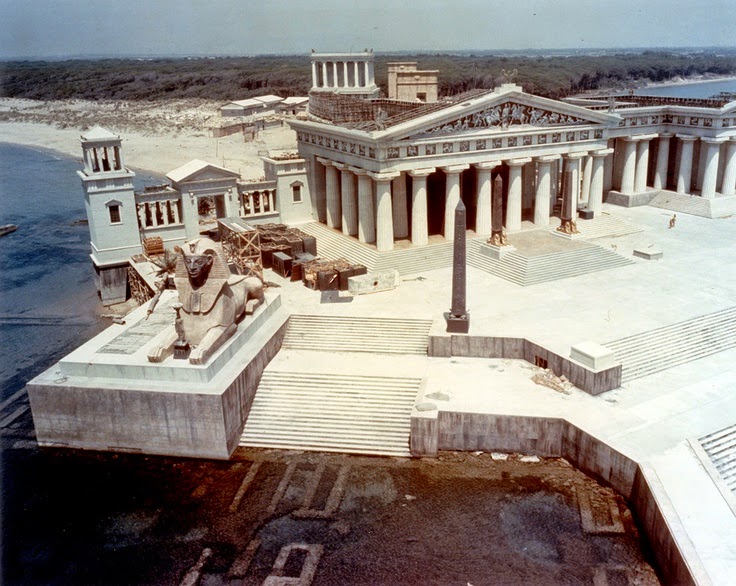
Time marched onto the summer of 1960 and general photography was about to commence in London. A cast had been assembled along with a massive set construction project spearheaded by art director John DeCuir, who had won an Academy Award for his work on THE KING AND I (1956). One of the largest and impressive set pieces built was the ancient Egyptian port of Alexandria.
The final set included four 52- foot- high statues which covered 20 acres with a staggering cost of over $600 thousand. The project not only requested the use of every carpenter, painter and builder available… it also put a huge dent in supply and building products throughout the entire country.
Visible tracheotomy scar
It would seem as if things were looking to move forward in a steady pace, until Taylor’s lingering illness would worsen due to the damp weather conditions of London. Her health finally escalated to a case of double pneumonia and, on March 4th 1961, led into slipping into a life- threatening coma. Doctors had to work swiftly and performed an emergency tracheotomy to keep her breathing. The visible scar from the incision at the base of her throat is visible throughout the finished film. Taylor was rushed back to the United States for immediate rest and recuperation; this period spanned the length of six months in which production was also shut down until photography could commence again. During the time, rumors had already flown across the pond that Elizabeth Taylor was dead! Those were exactly the stories the press needed to run with before even gathering factual information. The execs at Fox were probably more panicked than mournful with their financial investment being pronounced dead. Upon Taylor’s recovery, she happen to read her own obituaries and jokingly said, “they were the best reviews I’d ever gotten.”
Fox took careful assessment of its costly production with many changes occurring during Taylor’s hiatus. For one, director Rouben Mamoulian eventually resigned after his committed two years to the project, leaving Fox with a production that already ran up to $7 million. At the end of it all, Mamoulian’s direction presented Fox with only 10 minutes of usable footage. Taylor suggested her SUDDENLY, LAST SUMMER director to take the helm.
Directing Taylor (l) Joseph Mankiewicz (r)
Enter Joseph Mankiewicz. His flair for presenting classic historical epics was present in 1953’s JULIUS CAESAR and it was then decided that he would be hired on to direct CLEOPATRA. Upon his arrival, Mankiewicz read the Mamoulian script and felt it lacked of excitement and drama. Chewing off more than he bargained for, over- night re-writes of the script were occurring immediately. As for the rest of the cast, both Finch and Boyd also dropped out of the film due to prior commitments and extensive waiting periods for Taylor’s recuperation. Upon extensive meetings with Fox execs, producers and a suggestion or two from Ms. Taylor herself, the role of Julius Caesar would ultimately befall actor Rex Harrison.
Burton (l) and Harrison (r)
Harrison had primary been known, at the time, for his theatre work and was suggested to play Caesar by Taylor herself. The next major casting decision fell upon who would play Mark Antony. A choice made that had been originally rejected by Taylor herself, would be one that would linger into her personal and professional career and help cause one of the biggest scandals in Hollywood history. Enter Richard Burton. The final casting was still considered incomplete and the Fox board was now squeezing Skouras for a release date. Knowing that the previous production had been scrapped with no useable footage, the showman that was Skouras, promised that CLEOPATRA would be the greatest epic ever filmed. The execs bought it and re-shooting was ready to proceed… yet again.
PRODUCTION NIGHTMARES
The Alexandria set as it appeared at Pinewood Studios
One of the main reasons that none of the previous footage could be used was due to the gloomy, cloudy and misty conditions of jolly ol’ England that were captured on film. Most outdoor shots showed unavoidably murky backgrounds… hardly the backdrop required to recreate the desert landscape of Alexandria. In 21st century sense of filmmaking, a director can now merely request that a large portion of an exotic or expensive set be designed by way of a computer. This was obviously not the case in 1960. So, poor weather and the consideration of Elizabeth Taylor’s health, forced the production to move to the warmer climate of Italy. Fox was also hoping to cut production costs with the Italian six- day work week as well.
Art director John DeCuir had to tear- down the costly and labor- intensive sets build at the Pinewood Studios before leaving London. The most disappointing outcome was that not one frame of production film was kept in the final cut. No, DeCuir would have to rebuild the entire and extensive sets again in Italy. Mankiewicz dubbed DeCuir “the city planner” with the second building of the Roman Forum, which was said to have had been three times larger than the real one. The original ruins lay but only a few miles away from the set. As were the results during the London production, Italy also quickly exhausted its building materials and laborers… so much so that both were requested by nearby countries to help complete construction.
Cleopatra arrival into Rome
As production moved on, one of the most elaborate and breathtaking sequences was the arrival of Cleopatra to Rome for the first time. The scene required a cavalcade of charioteers, archers, dancers, jugglers, elephants and various other entertaining sights that would precede Cleopatra returning to Caesar, having borne his son in Egypt, by riding through the Roman Arch of Titus. Art director DeCuir was told to spare no expense in recreating the grand entrance. Cleopatra and son would ride in atop a Sphinx, pulled by hundreds of Nubian slaves. The Sphinx was to have had the appearance of black marble, so it was constructed out of fiberglass and plaster and was attached to a wood and steel frame and measured 35 feet tall and 70 feet long. During the actual filming, nearly 6,000 extras were hired to cheer Cleopatra’s arrival… when cameras rolled, however, the exuberant crowd instead cheered, “Liz! Liz! Liz!”

The full- sized barge
Just as elaborate and expensive as was the arrival into Rome, another costly piece would be the construction of Cleopatra’s barge upon its arrival at Tarsus. The massive sailing vessel was built to actual size with a price tag of $277 thousand. At the end, an estimated 79 sets were constructed.
Cleopatra's "gold" costume
Sets were not the only expensive items necessary in the story telling. Costumes took an extensive bite out of the budget as well. The Costume Designing team of Irene Sharaff, Vittorio Nino Novarse and Rene created over 20,000 different costumes for the actors and extras. The armies of extras required 8,000 pairs of shoes. And then, there was Elizabeth Taylor who would have a staggering 65 costume changes, including a dress made of 24-carat gold cloth. Her wardrobe tallied up to $194,800 in costs.
The iconic Cleopatra image would create a huge impact of fashion and make-up trends of the early 1960’s. A 1962 Revlon commercial featured the Cleopatra look by introducing the “Sphinx Eyes” appearance. Other items like snake rings and arm cuffs and long maxi dresses would also be part of all the rage.
Although the production side was extensive, massive and expensive… we still haven’t touched on the real drama that could have single- handedly sunk the entire production. For now the introduction of Elizabeth Taylor and Richard Burton will be made and the real drama of this turbulent saga could begin!
THE STORY THAT WAS TAYLOR AND BURTON
In the summer of 1961, after production had moved to the warmer climates of Italy, Taylor had now returned to the set after her six- month medical absence. The time would come for Taylor to work opposite the newly hired actor who was replacing Stephen Boyd’s Mark Antony, that actor was Richard Burton.
Burton’s career, at the time, was primarily that of the stage. He had just won a Tony as King Arthur in CAMELOT. Fox actually bought out his contract in New York and contracted him with a salary of $300 thousand. This would be an ideal opportunity for Burton, being that this was the biggest film he had ever done and the chance to film on location in Rome. Despite being married for 12 years, he had a reputation of romancing his leading ladies. Burton didn’t care much for Taylor’s reputation and had shared his feelings about her well before he even stepped foot on the set. Taylor didn’t know much about him, other than his womanizing behavior and kept to her guard since she had just recently married singer Eddie Fisher… a scandal all its own since he had been married to actress Debbie Reynolds when they were dating. Burton also carried the reputation of drinking.  The latter was discovered quickly as Burton arrived to work the day before filming was to begin: drunk. Hardly able to stand as he staggered around aimlessly, it was Taylor who took him and offered him coffee and a place to pull himself together. The first impression was hardly impressive, but her image of him prior to his arrival was that of arrogance and a bloated ego. Taylor soon found out for herself that he was quite charming. The first day of filming was now here and both actors took the scene. The results were ‘electrifying’, as told by on- lookers and crew. The chemistry was definitely present and both actors began living the roles of helpless lovers.
It was only a matter of weeks when the media ran with the rumored stories reporting everything from public affection, photographing the couple on private yacht excursions and anything else they could run with. As the relationship intensified, the affair became the kind of fodder that appeared everywhere from mainstream magazines to prime- time TV comedy sketches. The type of controversy created in its time was probably considered far worse than anything we might see or hear in present day. For one, actors and studios alike paid big money to publicists and photographers to help create a certain look and likable personality for the fans to relate to. The reputation of such “stars” were the fuelling basis to every fan base… they could make or break you. Taylor’s reputation was severely on the line when she was considered a ‘home wrecker’ in the marriage of Eddie Fisher and Debbie Reynolds, both considered major stars in their own rights. Her coma and near- death experience actually gained the fans’ sympathies and her dignity was restored. Reports of the affair affected Taylor on a personal level. She was actually denounced by the Vatican and on the floor of the United States congress, accused of just not being irresponsible, but immoral as well.
It seem as if the board and executives at Fox were deeply concerned that the Taylor- Burton rumors would destroy the heavily- invested project. The money would be lost with nothing to show for it. The Fox PR department thought very differently, however. The most heated topic could actually be used to draw attention to the film and make people come out to see what was translating onto the screen. The end of production and the release of the film would be the final proof as to whether or not the investment was worth it.
POST- PRODUCTION AND RELEASE
When the film finally wrapped, Fox had ended up spending over $30 million (the amount translates to approximately $300 million by today’s costs) and 96 hours’ worth of film shot spanning 400 days. Because of the extensive amount of film, director Joseph Mankiewicz considered two separate films in regards to the two acts: CAESAR AND CLEOPATRA and ANTONY AND CLEOPATRA. The studios quickly realized that they wouldn’t be able to capitalize on the hot publicity and that paying audiences would not be interested in the first film and would be left clawing to see the drama between Taylor and Burton, which wouldn’t be seen until the release of the second chapter. Fox asked Mankiewicz to condense both proposed films into one giant epic.
The first cut of CLEOPATRA was submitted at a running time of six hours long. After much editing, the film finally made its premiere. Opening in New York on June 11, 1963, the cut had slimmed down to 4 hours and 3 minutes, requiring 49 pages of reshoots to make sense of the cut. A week later, it was reduced to 3 hours and 42 minutes. The 50th Anniversary blu- ray release clocks in at 4 hours and 11 minutes.
The critics’ were discouraging, but Fox’s PR team came through by peeking the general audiences’ interests. The film grossed over $26 million, making it one of the highest grossing films of 1963. Despite the numbers, it still wasn’t enough to recoup the money invested by Fox. Producer Walter Wanger blamed the executive board and the lack of a completed script and poor production planning for its failure. The film had reportedly finally broke even in 1973 to which Fox “closed the books” to keep any and all profits a secret thereafter.
Elizabeth Taylor and Richard Burton married on March 14, 1964 and would work together on 11 more films including WHO’S AFRAID OF VIRGINIA WOOLF? For which Taylor would win her second Academy Award. The love- hate relationship caused a divorce in 1974, only for the couple to remarry again in 1975 and redivorce in 1976. It was reported that their interchanges lasted until Burton’s death in 1984.
CLEOPATRA was recognized on Academy Award night in 1964. The film won in the categories of Best Cinematography, Best Costume Design, Best Visual Effects as well as Best Art Direction. Ten people, seven Art Directors and 3 Set Decorators, were awarded the Best Art Direction award. It remains the largest number of people sharing a single award in an annual category. The other nominations were: Best Picture, Best Actor (Rex Harrison), Best Editing, Best Score and Best Sound.

FINAL THOUGHTS
JER standing in front of Darryl Zanuck's house in Palm Springs
Considered a huge gamble, did CLEOPATRA live up to the expectations of those involved? Was it truly the Greatest Epic Of All Time? I guess it really does boil down to the individual who watches this film. Some can appreciate the complexity and the detail in the production as well as appreciate and admire both direction and acting. While there are those who will feel the film is lengthy, even bloated, a large spectacle of nothing with lots of money blown on a thin storyline and drawn out to incoherent viewing. Still, it must be scrutinized and looked upon with a certain kind of openness to really get the full feel of the project. I close this up with a final quote from director Joseph Mankiewicz as he referred CLEOPATRA as “the toughest three pictures I ever made.”

What are your thoughts, readers? A spectacular epic or a spectacular flop? Share your thoughts on the epic films of today and yesterday for viewing and share your feelings right here! All comments will be replied to. I thank you for visiting and I do hope you will join me next month as I post a new topic entry on Thursday August 28th, 2014.